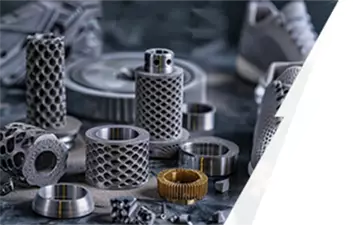

Silicon Carbide 3D Printing Service
SiC offers ultra-high temperature stability (1600-1700°C resistance), extreme hardness (Mohs 9.5), high thermal conductivity (120-490 W/m·K), and chemical inertness. Advanced processes like binder jetting (zero shrinkage during sintering), stereolithography (enhanced curing depth to 244μm via PMMA light channels), or powder extrusion (PEP technology for near-net shaping) enable complex green body fabrication.
Common 3D printable products:
- erospace & High-End Optics Fabrication of large-aperture lightweight mirrors
- Energy & Industrial Equipment SiC heat exchangers for chemical industry
- Electronics & Semiconductor Manufacturing
What do you want printed?
You can also send us 3D object files at our Email:Jerry.xiao@julyn.cn


Aluminum (AlSi10Mg) Material Properties
| Product name | FormAlox 999 | FormAlox 998 | FormAcon 3Y |
| Product description | Engineering alumina parts, manufactured using LCM additive manufacturing method | Engineering zirconia parts, manufactured using LCM additive manufacturing method | |
| Material | Aluminum oxide (Al O2 3) | Aluminum oxide (Al O2 3) | Zirconium oxide (ZrO3 mol-% Y O2 3 stabilized) |
| Purity | 99.9 % | 99.8 % | 99.8 % |
| Density | 3.985 g/cm3 (99.4 % of theoretical density) | 3.985 g/cm3 (98.4 % of theoretical density) | 6.088 g/cm3 (99.4 % of theoretical density) |
| Hardness HV10 | 1550 | 1550 | 1250 |
| Bending strength | 430 MPa (4-point) | 400 MPa (4-point) | 930 MPa (4-point) |
| Young‘s modulus | 300 GPa | 380 GPa | 205-210 GPa |
| CTE | 7-8 ppm/K | 7-8 ppm/K | 10 ppm/K |
| Thermal conductivity | 37 W/mK | 29 W/mK | 2.5-3 W/mK |
| Surface roughness Ra | ~ 0.4 µm | 0.9 µm | ~ 0.3 µm |
| Max. operating temp. | 1650 °C | 1650 °C | 1500 °C |
| Color | White | White | White |
| Size | Max.: 84.9 x 51.4 x 156.8 mm Wall thickness: up to 4 mm | Max.: 84.9 x 51.4 x 156.8 mm Wall thickness: up to 5 mm | |
How Does Ceramics 3D Printing Work?
First, design a 3D model using CAD software, which is then sliced and imported into the printer. During printing, depending on the technology (such as stereolithography, fused deposition, or powder bed fusion), ceramic slurries, powders, or filaments are stacked layer by layer, with strict control over layer thickness and precision. The printed “green body” contains binders or solvents and must first undergo low-temperature debinding (e.g., 100-600°C) to remove organic matter, followed by high-temperature sintering (1300-1600°C) to densify ceramic particles and form high-strength final products. Some processes also require subsequent grinding and polishing to improve surface accuracy.

Get An Accurate Quote Quickly
If you have 3D printing needs, you can leave your email address, and we will reply to you within 30 minutes.
Email:
jerry@coreprint3d.com
Phone:
+86:180 2696 3929
Jieshun Technology Center, Longhua District, Shenzhen
Dongguan Songshan Lake International Innovation and Entrepreneurship Community