
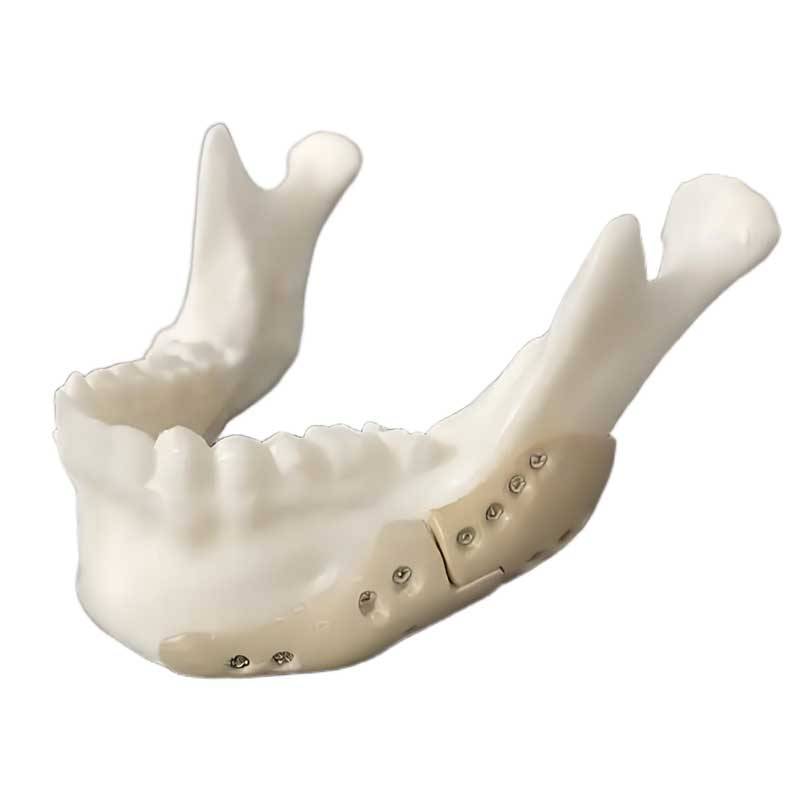
描述
Advantages of Medical Ceramic 3D Printing:
-
1.High Customization for Precise Patient Matching
Generates personalized implants (e.g., joint prostheses) directly from CT/MRI data, perfectly fitting bone defects and avoiding adaptability issues of traditional implants.
Designs exclusive shapes for complex anatomical structures (e.g., irregular bone defects, growing pediatric bones), enhancing treatment outcomes. -
2. Biocompatibility and Safety
Materials like hydroxyapatite and β-tricalcium phosphate mimic natural bone composition, inducing osteocyte adhesion/growth and promoting osseointegration while reducing rejection risks.
-
3. Controllable Mechanical Properties and Biomimetic Structures
Adjusts printing parameters (porosity, layer thickness, internal lattice) to match the mechanical strength (compression/bending resistance) of natural bone, minimizing “stress shielding” (bone atrophy from overly rigid traditional implants).
-
4. Improved Surgical Efficiency and Precision
Prints pre-surgical bone models or guides to assist in surgical planning and rehearsal, reducing operation time and intra-operative risks (e.g., complex fracture reduction, bone reconstruction after tumor resection).
-
5. High Material Utilization, Low Waste
Additive manufacturing deposits material only where needed, achieving over 90% material utilization for medical ceramics—far higher than traditional subtractive machining (which wastes >50% of material)—reducing costs, especially for expensive bioactive ceramics.
-
6. Support for Complex Structures and Functional Integration
Fabricates intricate geometries (hollow structures, gradient porosity, internal channels) unattainable by traditional methods, even integrating drug-delivery functions (loading antibiotics/growth factors in ceramic pores).
-
7. Reduced Post-Operative Complications
Implants that conform to bone surfaces minimize micromotion, wear, and interfacial inflammation, lowering risks of loosening or revision surgery.
| Product name | FormAlox 999 | FormAlox 998 | FormAcon 3Y |
| Product description | Engineering alumina parts, manufactured using LCM additive manufacturing method | Engineering zirconia parts, manufactured using LCM additive manufacturing method | |
| Material | Aluminum oxide (Al O2 3) | Aluminum oxide (Al O2 3) | Zirconium oxide (ZrO3 mol-% Y O2 3 stabilized) |
| Purity | 99.9 % | 99.8 % | 99.8 % |
| Density | 3.985 g/cm3 (99.4 % of theoretical density) | 3.985 g/cm3 (98.4 % of theoretical density) | 6.088 g/cm3 (99.4 % of theoretical density) |
| Hardness HV10 | 1550 | 1550 | 1250 |
| Bending strength | 430 MPa (4-point) | 400 MPa (4-point) | 930 MPa (4-point) |
| Young‘s modulus | 300 GPa | 380 GPa | 205-210 GPa |
| CTE | 7-8 ppm/K | 7-8 ppm/K | 10 ppm/K |
| Thermal conductivity | 37 W/mK | 29 W/mK | 2.5-3 W/mK |
| Surface roughness Ra | ~ 0.4 µm | 0.9 µm | ~ 0.3 µm |
| Max. operating temp. | 1650 °C | 1650 °C | 1500 °C |
| Color | White | White | White |
| Size | Max.: 84.9 x 51.4 x 156.8 mm Wall thickness: up to 4 mm | Max.: 84.9 x 51.4 x 156.8 mm Wall thickness: up to 5 mm | |


